















Blair Camera Co.
Cincinnati Reversible Back Improved Variation 1
Illustrated Catalogue and Price List of Photographic Apparatus and
Supplies, Section A, Blair Camera Co. (Boston, MA), distributed by
Oscar Foss (San Francisco,
CA),
1890, pp.
8-9
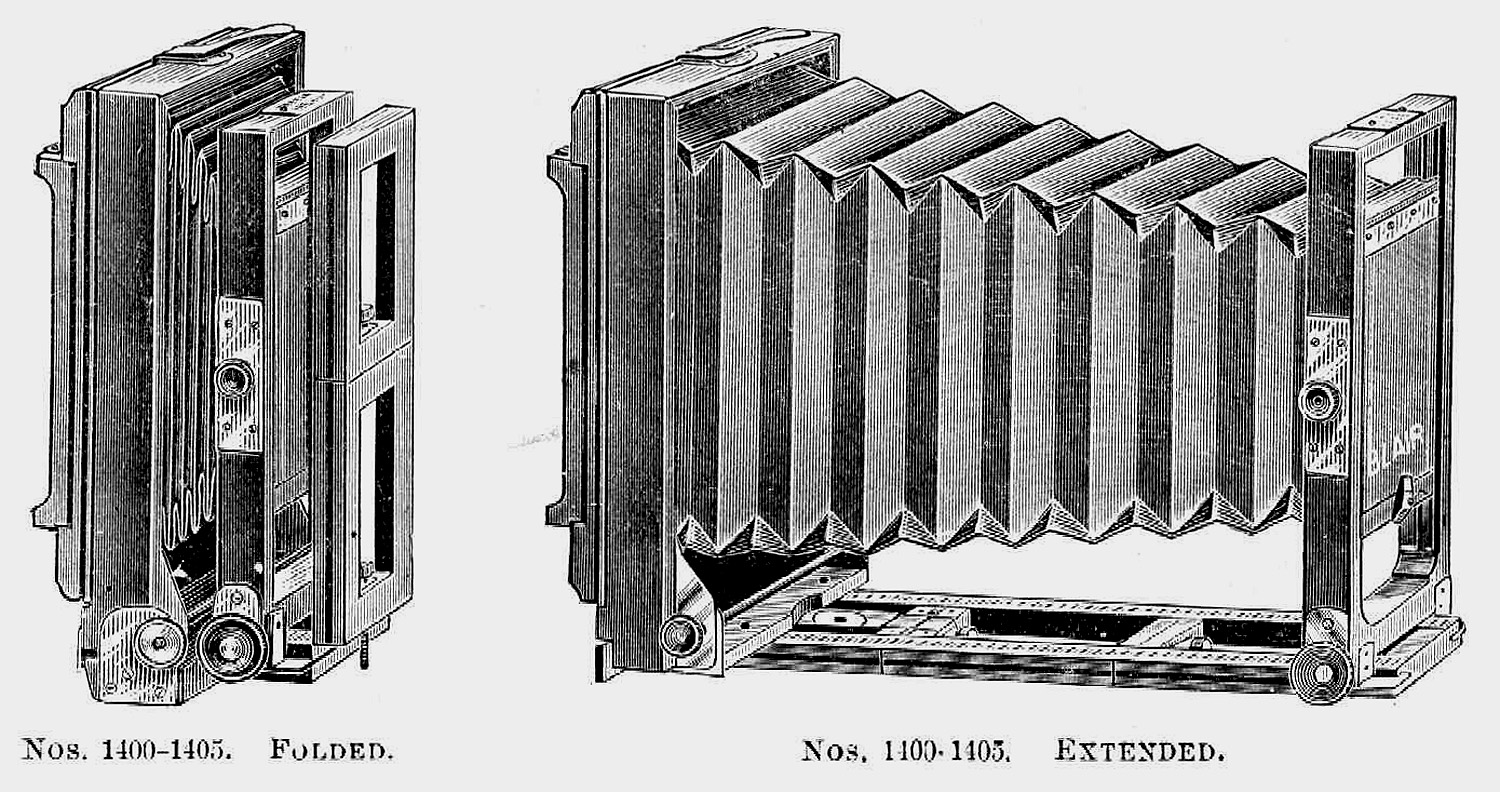
Date Introduced: - ;
Years Manufactured: c.1890-1895
The model name
Improved Cincinnati RB Camera is known from Blair catalogs from 1890
through 1895. The catalogs show a camera that is front focus, that has
a back tilt mechanism containing a brass plate whose top ends at a
45°
angle to the back, and has a simple base (unlike the complex base
of the
Improved Reversible Back, Variation 2, which, though having the
45° angle piece, was listed as a separate
model in the 1890 catalog). The catalog engravings associated with
the Improved Cincinnati RB Camera model name are referred to here
as Variation 1. There are also cameras extant that have
that same basic configuration but variations in details - these cameras
are referred to here as Variation 2,
Variation 2.5,
Variation 3, and a center swing
version introduced in the 1893 catalog, revered to as
Variation 4..
Cincinnati Reversible Back, Improved, Variation 1-- This is the
camera as shown in engravings in the 1890 and 1895 Blair Camera Co.
catalogs.
Cincinnati Reversible Back, Improved, Variation 2-- This is the
camera in the images on the Variation 2 page.
Cincinnati Reversible Back, Improved, Variation
2.5-- This is the
camera in the images on the Variation 2.5 page.
It differs in a small detail from
Variation 2 and Variation 3,
hence the name Variation 2.5.
Cincinnati Reversible Back, Improved, Variation 3-- This is the
camera in the images on the Variation 3 page.
Cincinnati Reversible Back, Improved, Variation
3.5-- This is the
camera in the images on the Variation
3.5 page.
Cincinnati Reversible Back Improved Variation 4--
This is the center swing version of Cincinnati Reversible Back Variation
1, as introduced in
Blair's Illustrated Catalogue and Price List of Photographic Apparatus
and Supplies 1893, page 3-5. This camera is rather negatively
described as center swing, in that the description on pages 3 to 5 does
not ever mention whether the camera is center swing or not. The
entire description seems to have been kept or lifted from previous
catalogs, presumably when Blair was selling a non-center swing
Cincinnati RB Camera.
Likewise, the engraving still shows a non-center swing version.
The only indication that the model is now center swing appears in an the
Appendix, p.49, in which a description of the previous
Cincinnati model reads, in part,
"These are very similar to the latest style (see page 8), except that
they are not center swing." This implies that the current 1893
variation of the Cincinnati RB Camera
is center swing. Such a center swing Cincinnati has not yet been
observed, though I don't doubt that some were manufactured. Chronology and Numbering-- Cameras
of this era did not generally have serial numbers. Sometimes,
small (up to several dozen) numbers are stamped onto parts that
must be fitted - these are assembly numbers, placed there to ensure that
they do indeed fit. That the numbers are always small indicates
the small number of cameras that were made in each batch.
Construction: front focus
via rack and pinion (two gear tracks on top of base rails);
single or double swing; reverse by removable back; three-piece lens
board
Materials: mahogany body; cherry base;
black fabric bellows; nickeled hardware
Sizes Offered: 1400=4x5 (illustrated);
1401=4¼x6½; 1402=5x7; 1403=5x8; 1404=6½x8½; 1405=8x10
Notes:
Base: a solid back base with two frame-type extensions.
The first extension is hinged to swing up for compact storage; the
second is either removable or hinged down (cannot tell from the
point-of-view of the engravings). The base is made rigid by
screwing each extension (via knurled knobs) into its adjacent base
part(s).
Back: has a slotted edge and attaches to the body via
two brass tabs at the bottom and a large, spring-loaded tab at the top
that fit into the slot.
Front Rise: a knurled knob threads into a brass plate
and, when tightened, presses an internal bearing plate located between
the front standard and lens board frame.
Back Tilt: a full width shaft fits through tilting
brass plates having 45° angle tops, and has
a threaded knob to tighten. Note, however, that there is a
variation in back tilt between the two engravings, even though they were
supposed to represent the same camera when appearing together in one
advertisement. The engraving on the left shows the tilt shaft to
be going through a fixed plate that is on the outside of the back
standard and attached by three screws to the fixed base that is
naturally the same thickness as the hinged base
extensions. The engraving on the right also shows a fixed
plate attached to a fixed base, but in this case, the fixed base is only
about ¼" thick - the thickness of the back
standard - and forms the bottom part of a box-like back standard.
The fixed plate attached to it in the right hand engraving is on the
inside of the 45° angle tilting
plate (and also inside of the wooden side of the back standard) instead
of outside, as in the left hand engraving. The placing of a
box-like back standard on top of a base is a commonly used
double-tilt mechanism, in which the box swivels relative to the fixed
base around a central bolt. Regardless of single or double tilt,
there is a basic difference between the engravings as to whether the
fixed plate for the tilting mechanism is outside or inside the tilting
plate. This difference is represented here as
Variation
1, left hand engraving and Variation 1, right hand engraving.
Base: three pieces, but differs from
Variation 1.
All three parts of the base are solid wood instead of a frame. The
frontmost hinge is on the bottom, allowing the front base to drop down,
presumably out of the view of wide-angle lenses. To facilitate the
drop, both parts of the base have been cut out on their bottom edge at
~45° for about a third of the thickness of the
base. The rearmost hinge is on the top (as usual),
for compact storage. Since the base is solid, knurled knobs as
were used in Variation 1 to make the base rigid cannot be used in this
variation. Instead, the front hinge is made rigid by two brads on
the top of the extension fitting into two clips on the top of the base,
and the rear hinge is made rigid by a kind of tongue and groove
mechanism, in that a thick slab of brass is grooved to match a
tongue-shaped slot inlet into the base and the first extension; when the
brass slab has been pushed forward to a position partially in the base
and partially in the extension, it theoretically makes the joint rigid.
In practice, the system has too much play - the brass piece would have
to be longer to function as desired. The slab also is threaded for
a standard-sized tripod screw. One feature that seems to be unique
to Variation 2 is that the last extension has a protective brass
capping piece inlet into its front. Formerly,
Variation 2
and Variation 3 were represented by 4x5" format cameras only.
It was therefore considered possible that their solid-type bases were used in small sizes only, and that
frame-type bases were used in large sizes. However, this idea was
negated when Variation 2.5, a
6½x8½" Blair Cincinnati RB Improved camera having a solid
base, was found.
Back: slotted and attaches in the same manner as
Variation 1.
Front Rise: controlled via a slotted brass plate and
screw rather than the solid brass plate & internal bearing surface of
Variation 1.
Back Tilt: is the same mechanism as
Variation 1,
right hand engraving.
Base: three solid, identical to those in
Variation 2and
Variation 3.
Back: slotted and attaches in the same manner as
Variation 1.
Front Rise: controlled via a solid brass plate &
internal bearing surface identical to that in Variation 1.
Back Tilt: is the same mechanism as
Variation 1,
right hand engraving.
Base: three
solid pieces,
essentially identical to Variation 2, although the front hinges
are different in detail. The extent of the ~45°
cut-out in the base at those hinges has been increased to about half the
thickness of the base. This variation does not have the
protective brass piece at the front of the base.
Back: does not have a slotted edge, and so differs from
Variation1 and
Variation 2. It attaches via four
clips: two clips on the lower side; each clip engages a brad on the
lower side of the back, and two clips on the top; each engages a brad on
the top of the back. The two small top clips replace the single
large clip that Blair used for many years.
Front Rise: is the same as Variation 2.
Back Tilt: is the same as
Variation 2, i.e., the
same as Variation 1, right hand engraving.
Base: three
pieces,
one solid and two extensions in front. Rather than the front
standard having flat metal pieces that travel is slots in the platform,
the front standard in this variation rides on metal rails, essentially identical to
the
Combination, RB, Variation 2.5. The
front extension is removable, so has no need of any cut-out to
facilitate hinging. This variation does not have the
protective brass piece at the front of the base.
Back: does not have a slotted edge, and so differs from
Variation1 and
Variation 2. It attaches via four
clips: two clips on the lower side; like
Variation 3.
Front Rise: is the same as
Variation 2
and Variation 3.
Back Tilt: is the same as
Variation 2
and Variation 3, i.e., the
same as Variation 1, right hand engraving.
The engravings in the catalogs are presumed to have
been produced prior to or just as the model was introduced, so the model
in the engravings was named Variation 1.
Generally, wooden view cameras became simpler and had
less inletting and hand work over time. Therefore, the variation
having the brass protective end on its extension was designated
Variation 2.
Variation 3 was named by process of elimination (at
least until another variation is discovered).
References:
Illustrated Catalogue and Price List of
Photographic Apparatus and Supplies, Section A, Blair Camera Co.
(Boston, MA), distributed by Oscar Foss (San Francisco,
CA), 1890, pp.
8-9
Illustrated Catalogue and Price List of
Photographic Apparatus and Supplies, Section A, Blair Camera Co.
(Boston, MA), 1893, p.
49
Anthony's Photographic Bulletin XXV No. 5, May 1 1894, p. xi
Illustrated Catalogue and Price List of Photographic Apparatus and
Supplies, Blair Camera Co. (Boston, MA), 1895, p. 8, 44