
















A. Semmendinger
(see
also
http://semmendinger-camera.com/)
Semmendinger Field View Camera Model/Variation 1
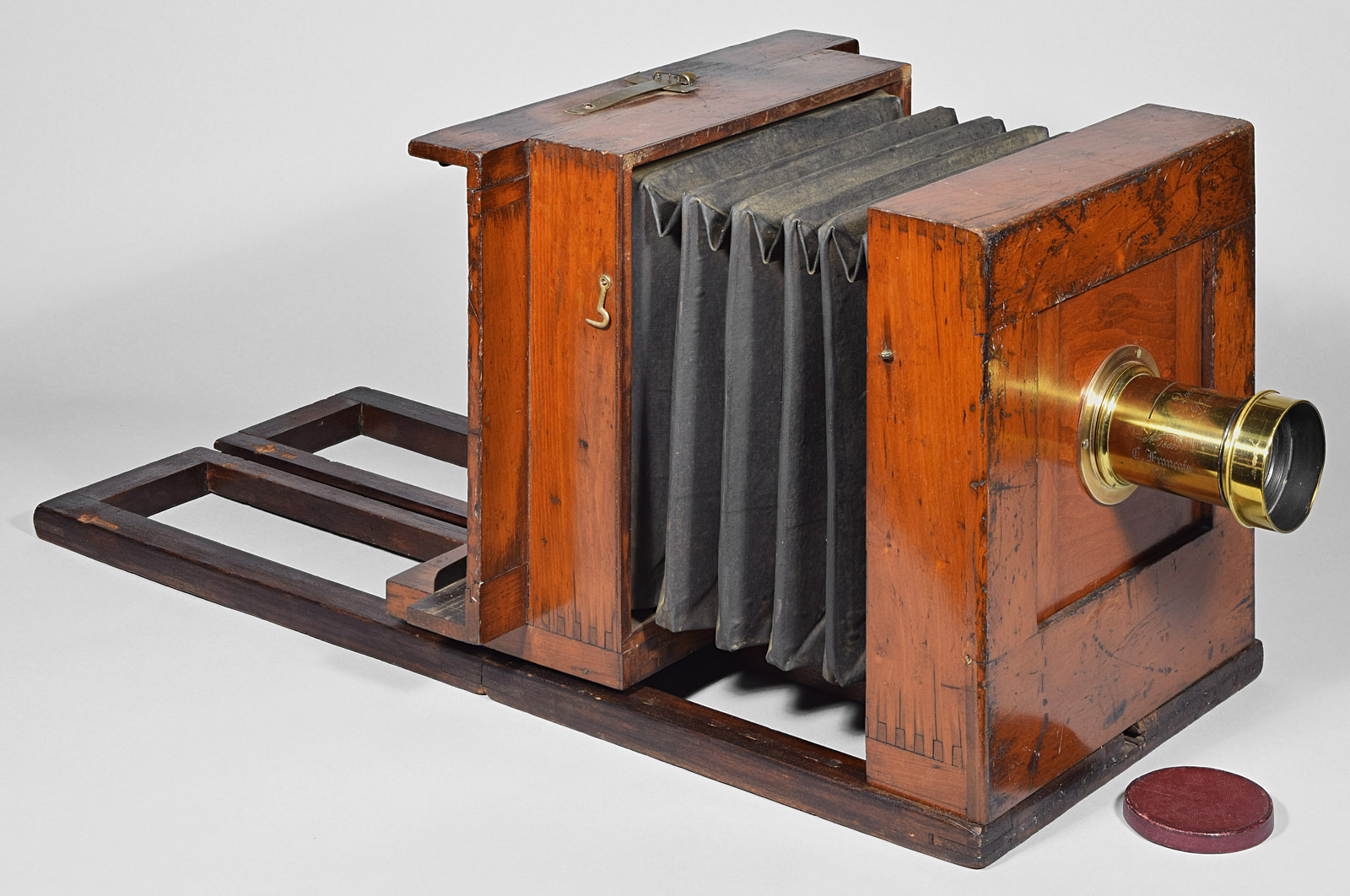
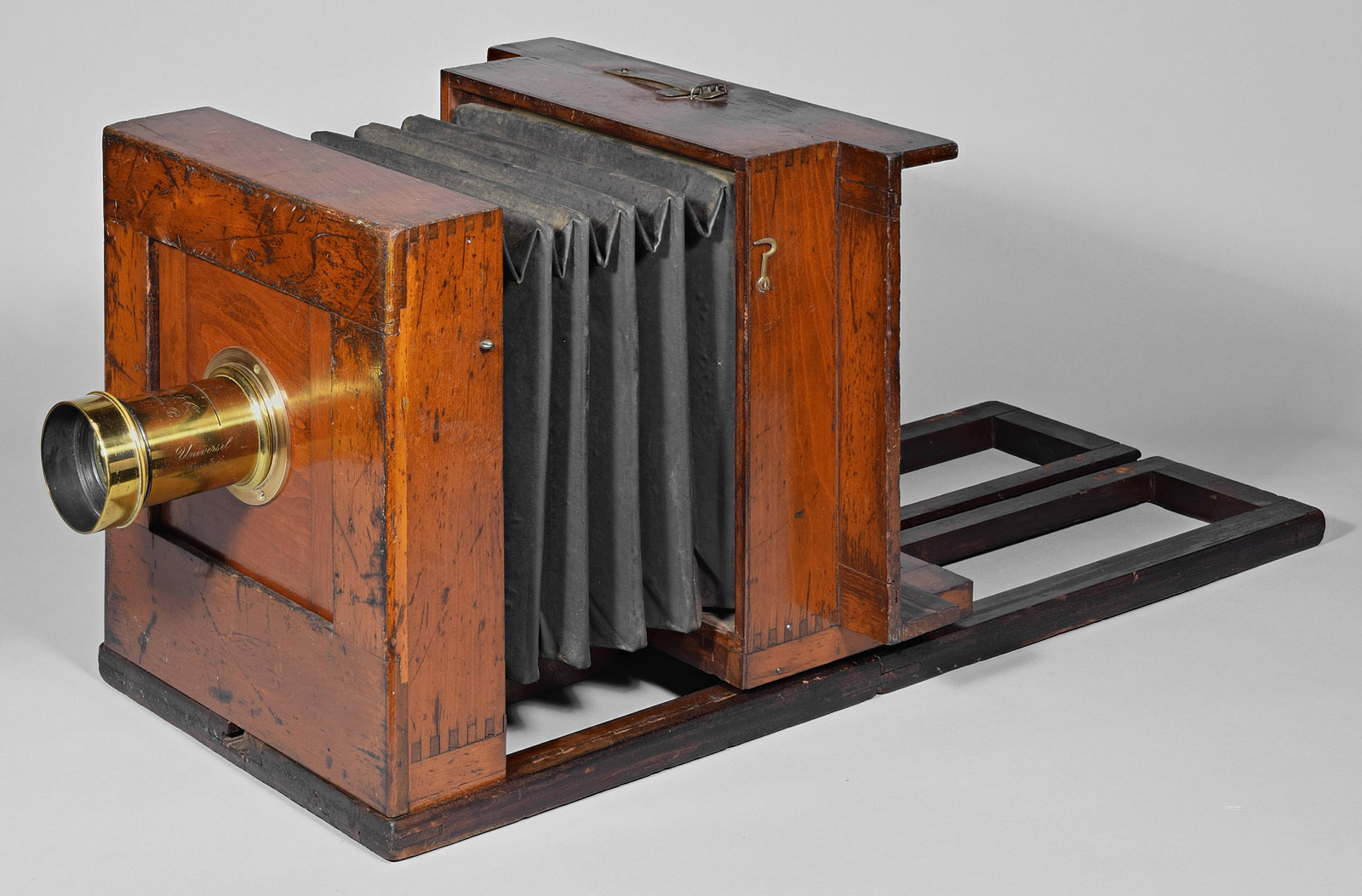
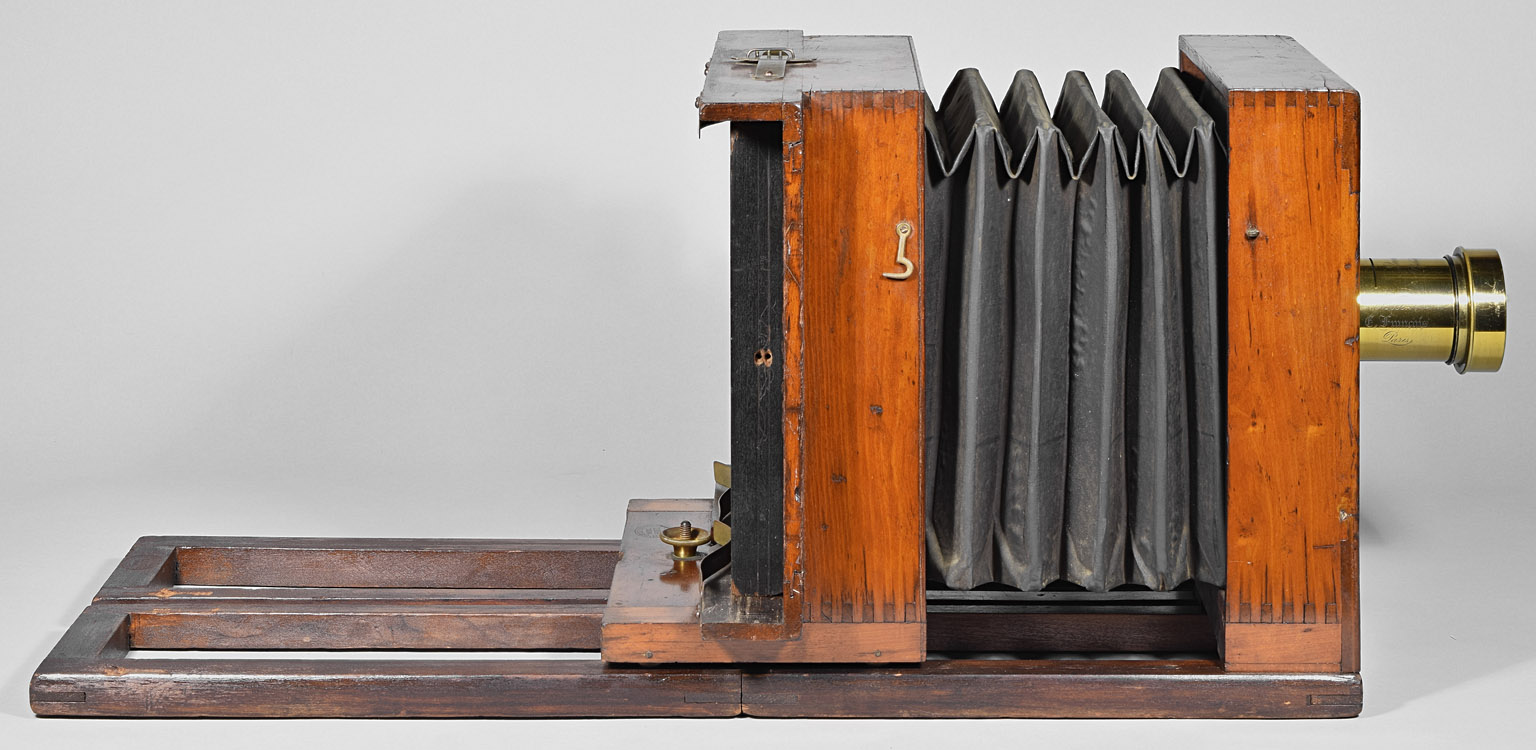
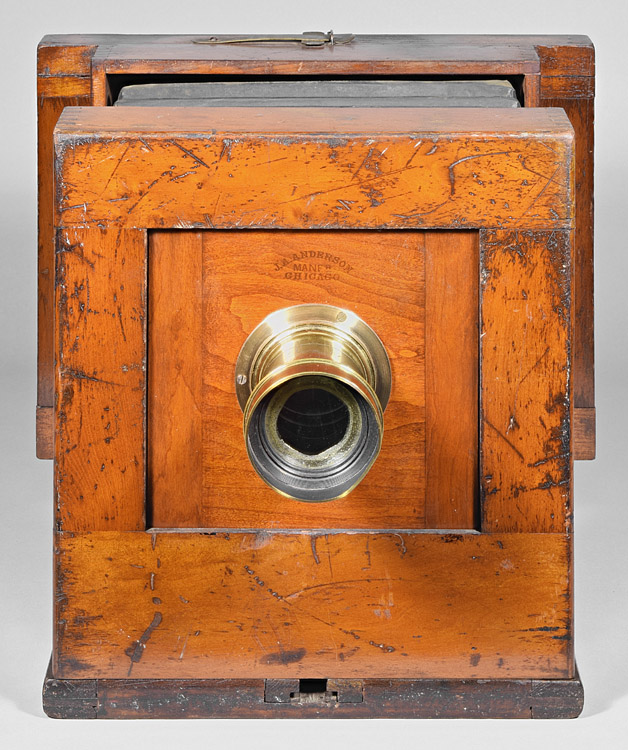
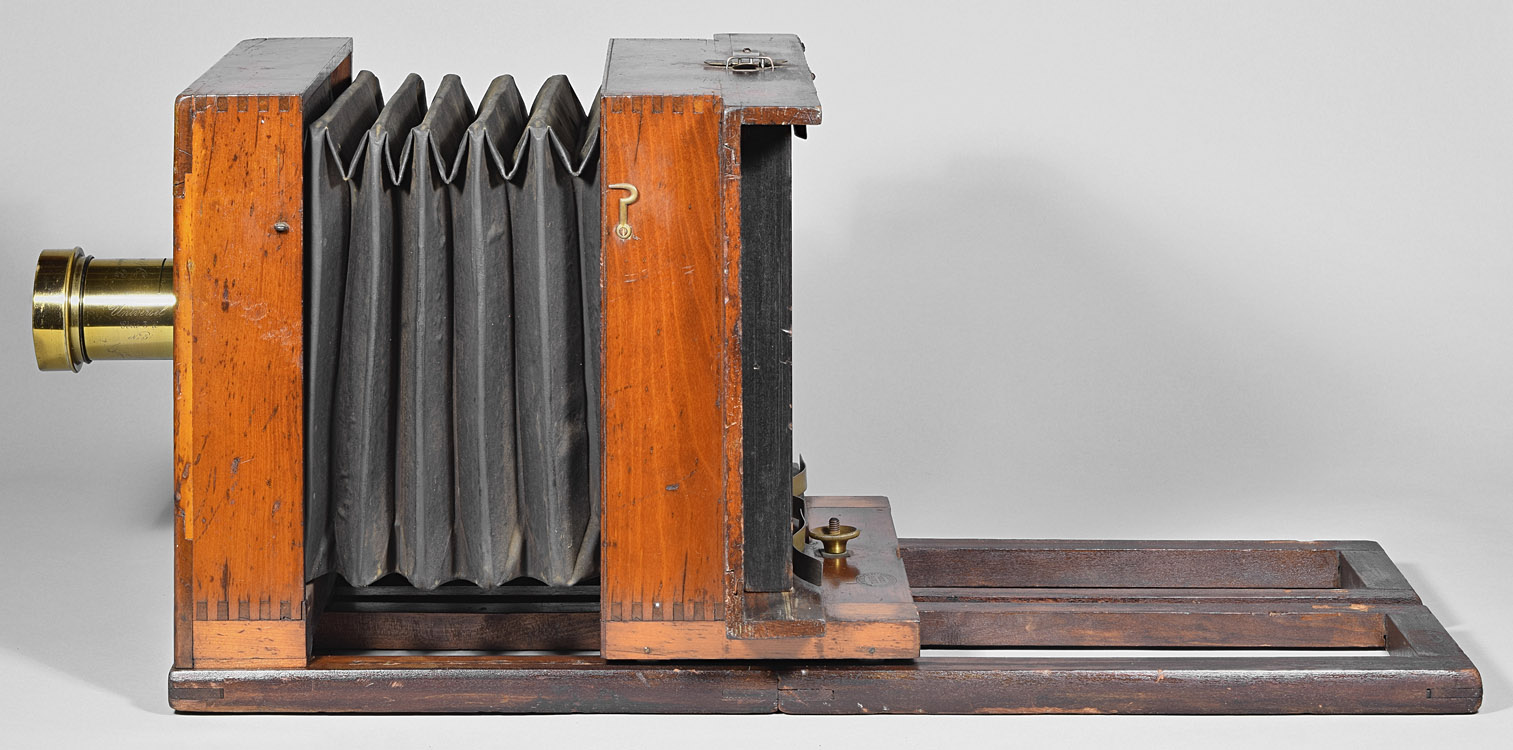
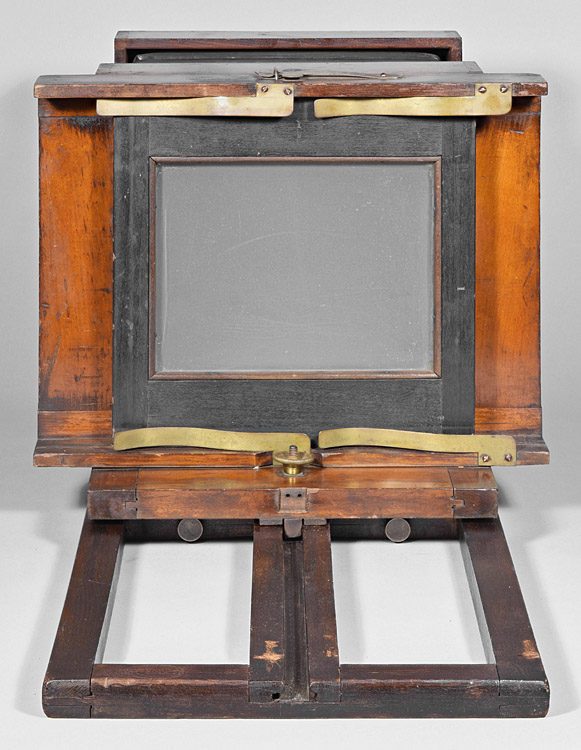
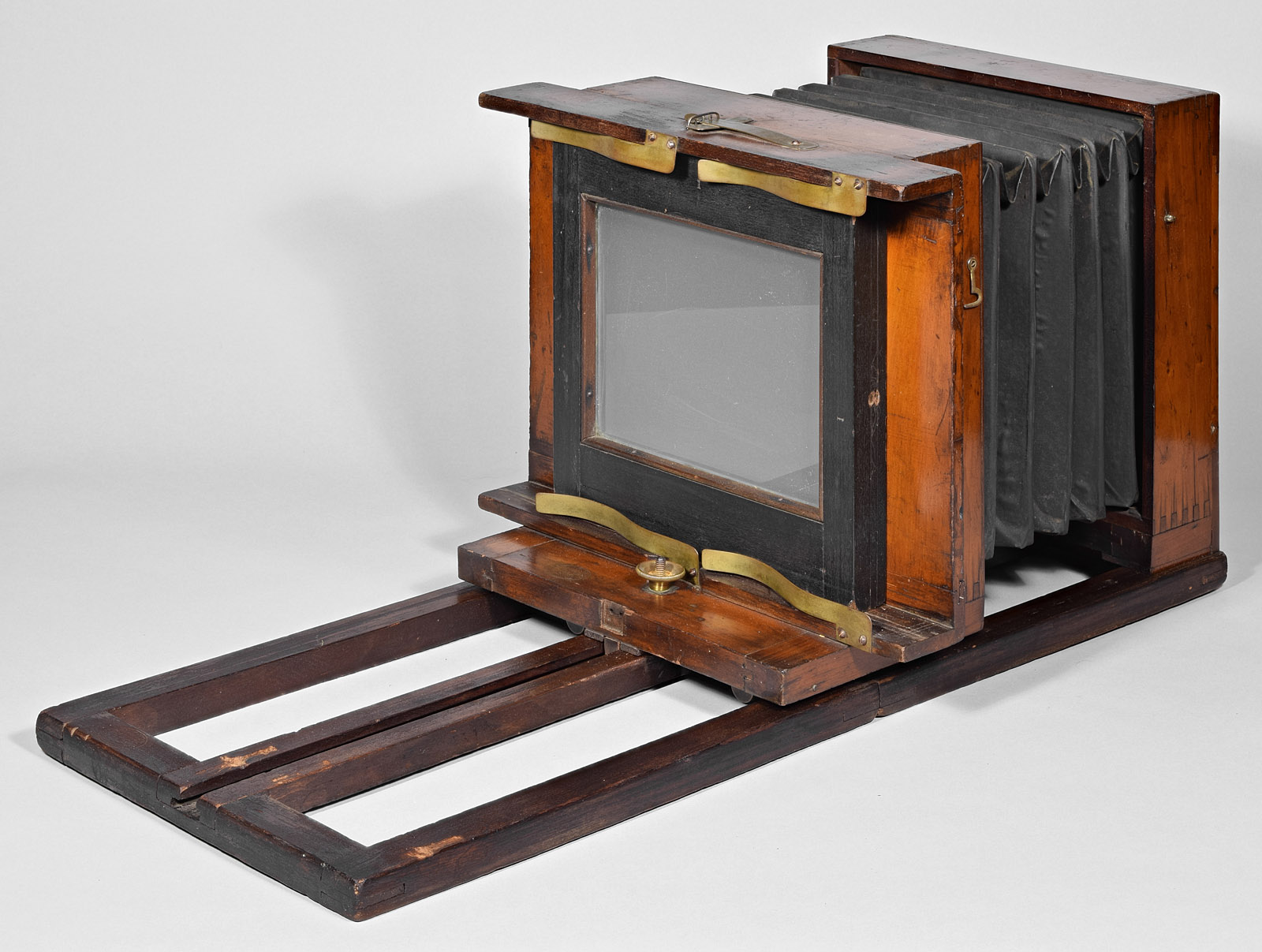
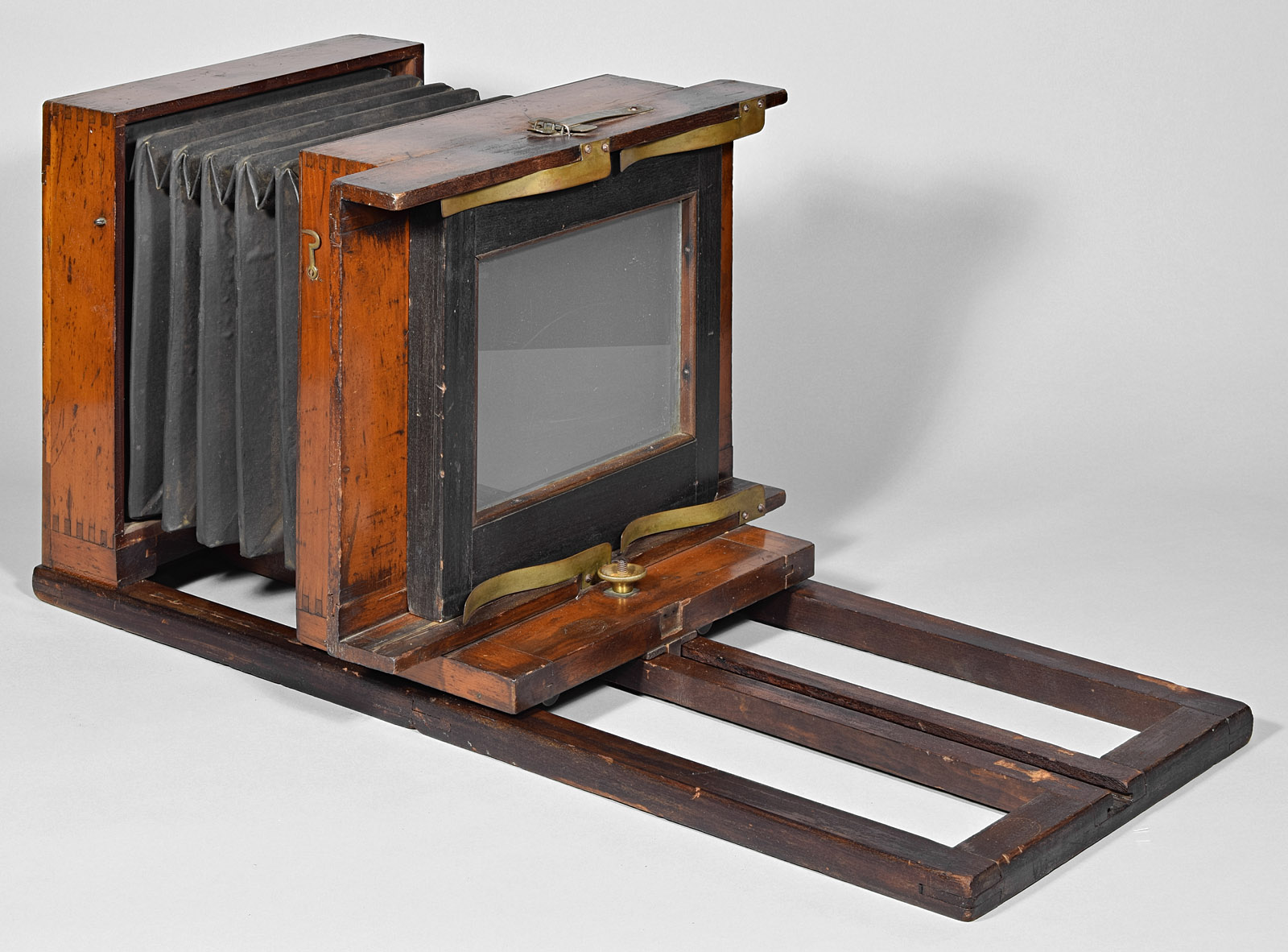
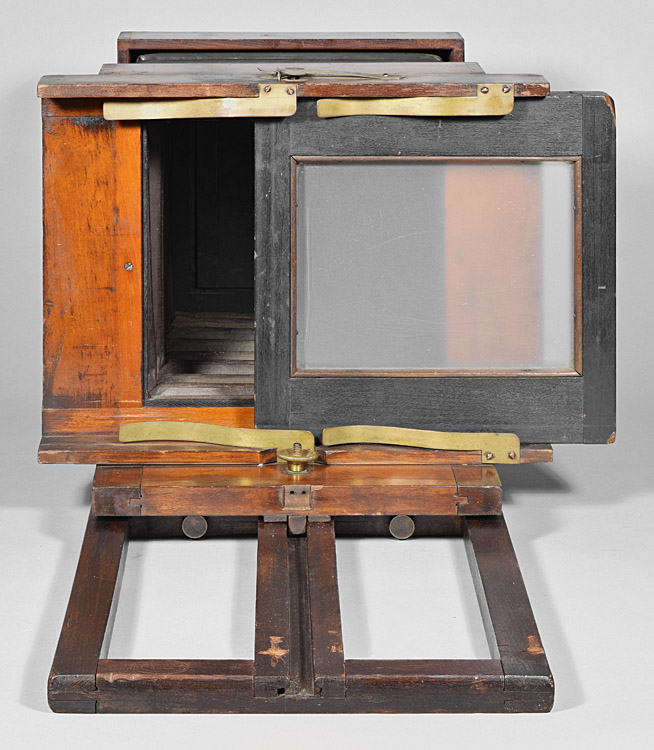
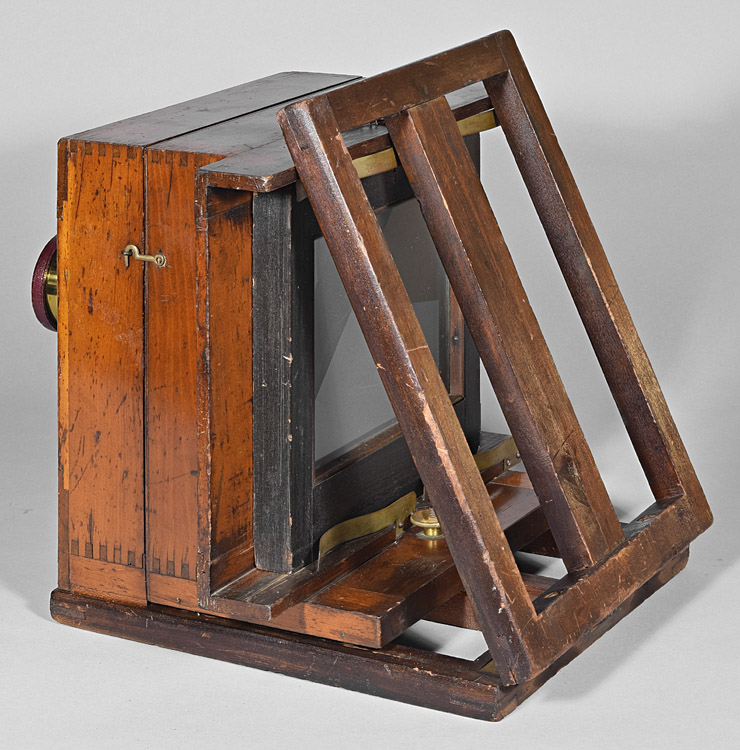
Left: Back view with ground glass frame
partially removed; Right: Folded
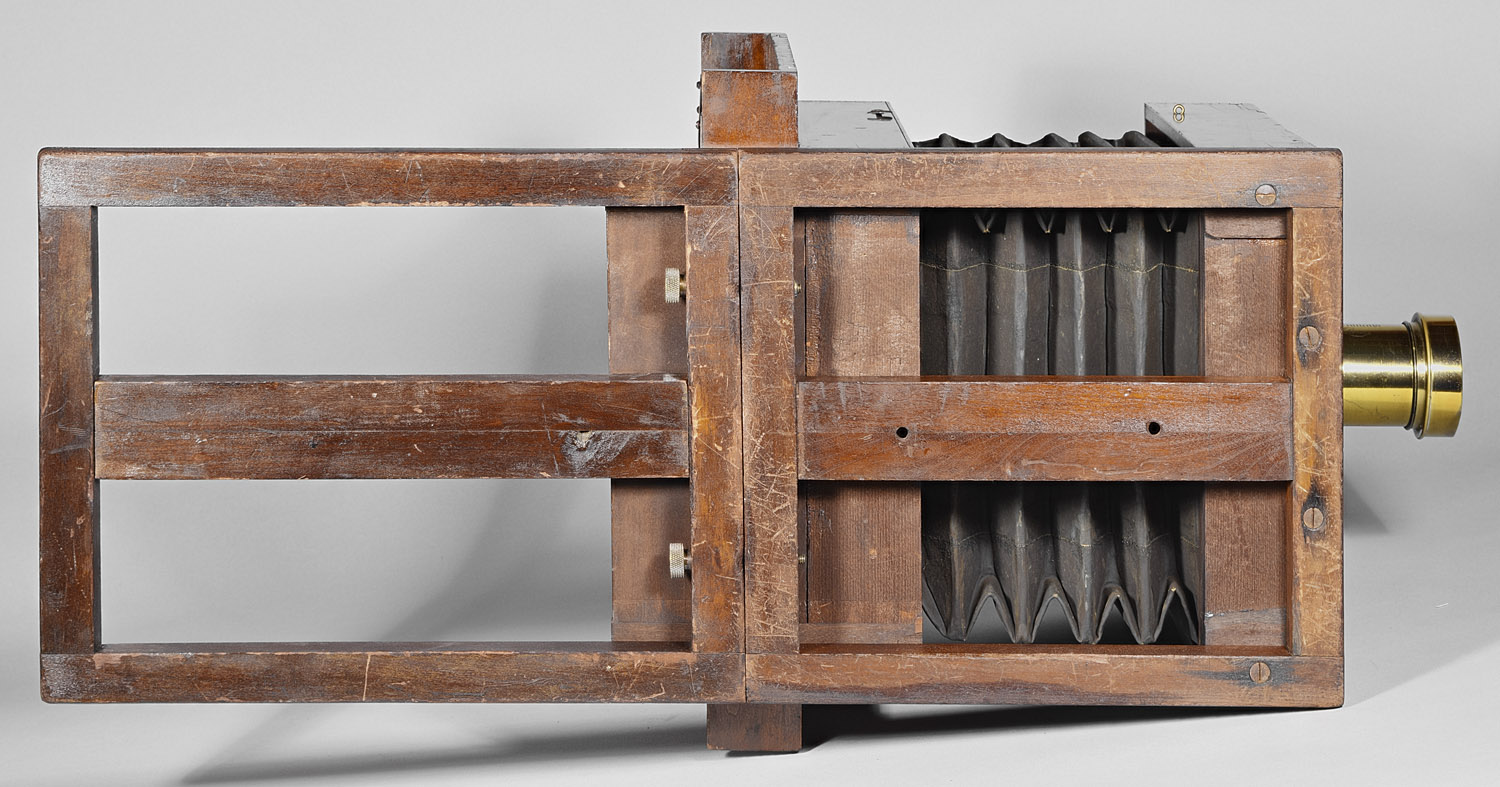
Bottom
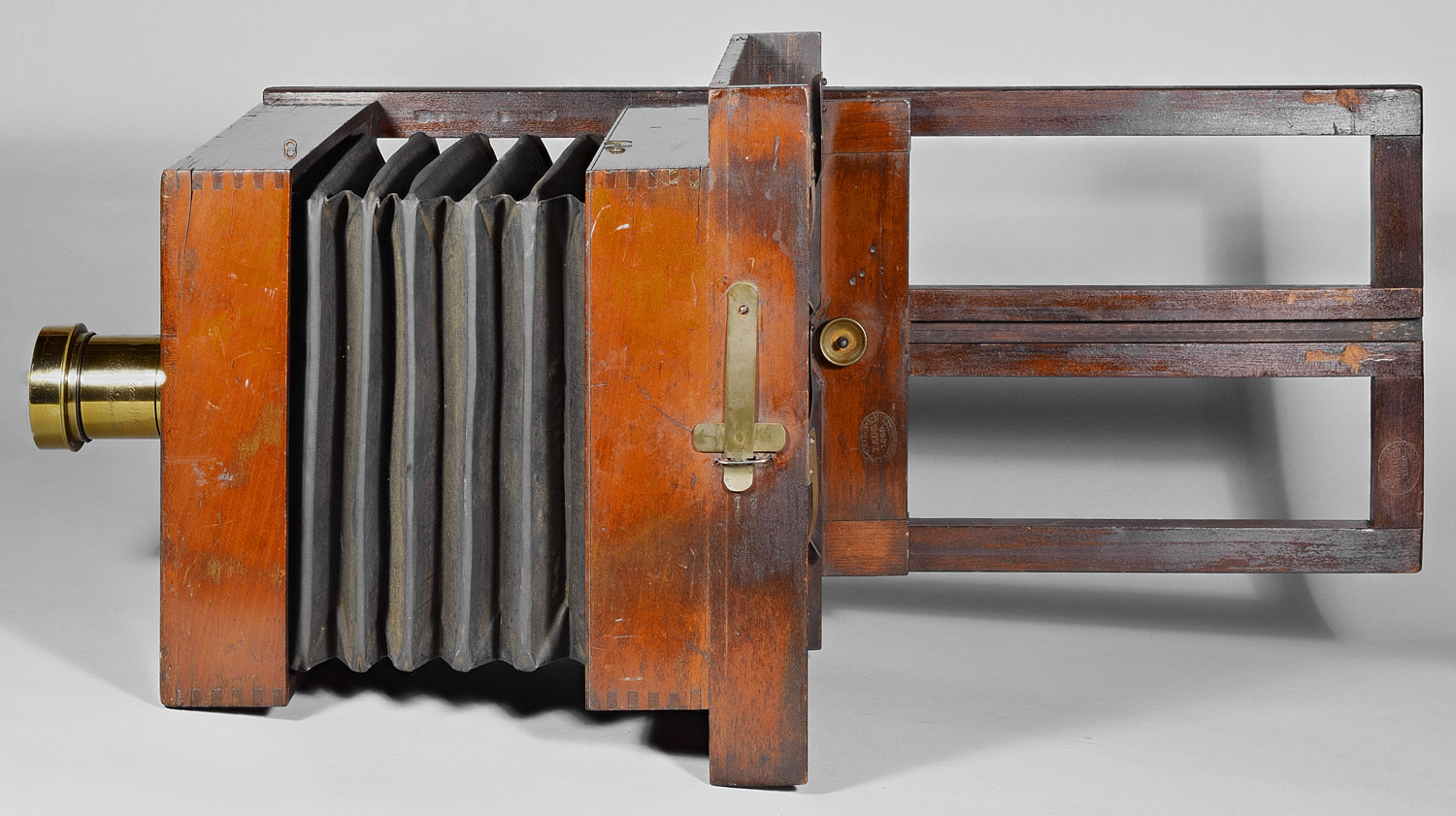
Top
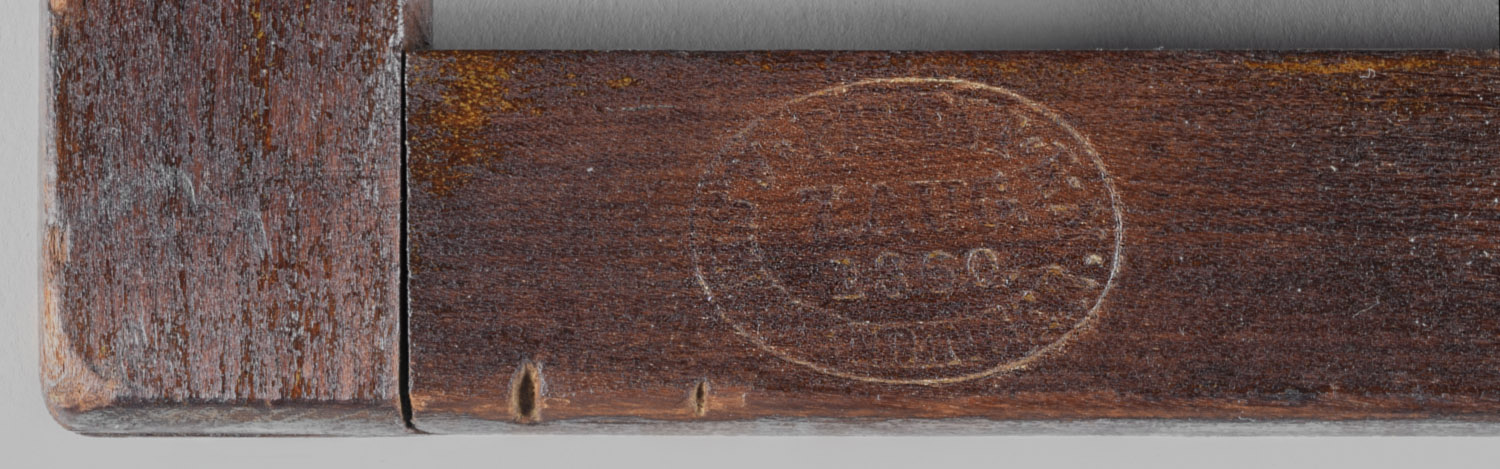
Stamp, top rear of platform: "∙ Patent ∙ 7 . Aug . 1860
∙ A. Semmendinger . N,Y ∙", one of three identical stamps on the camera
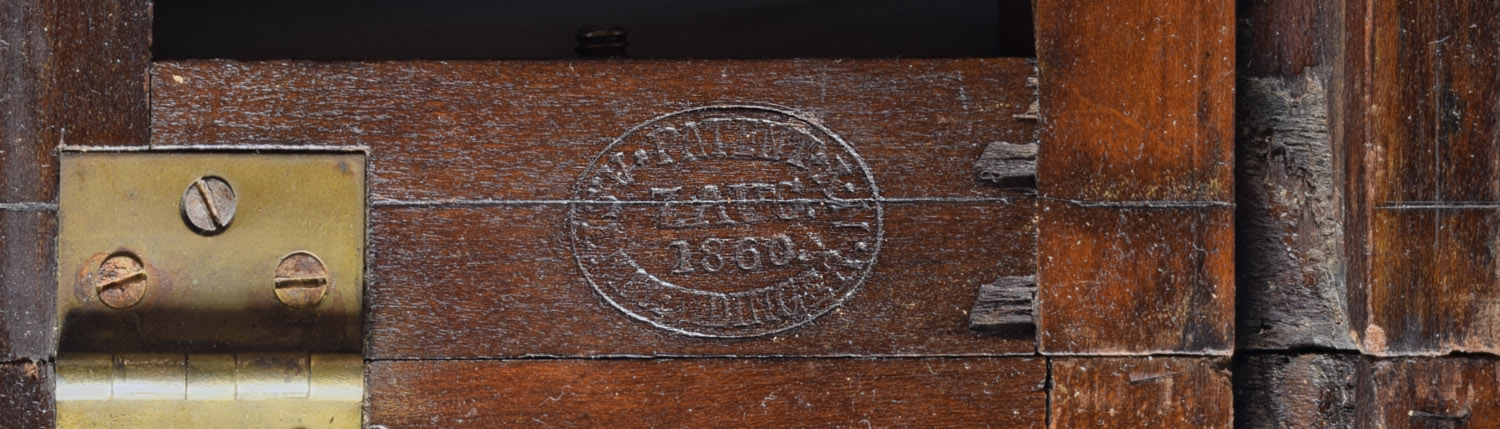
Stamp, top platform next to hinges: "∙ Patent ∙ 7 . Aug . 1860
∙ A. Semmendinger . N,Y ∙"
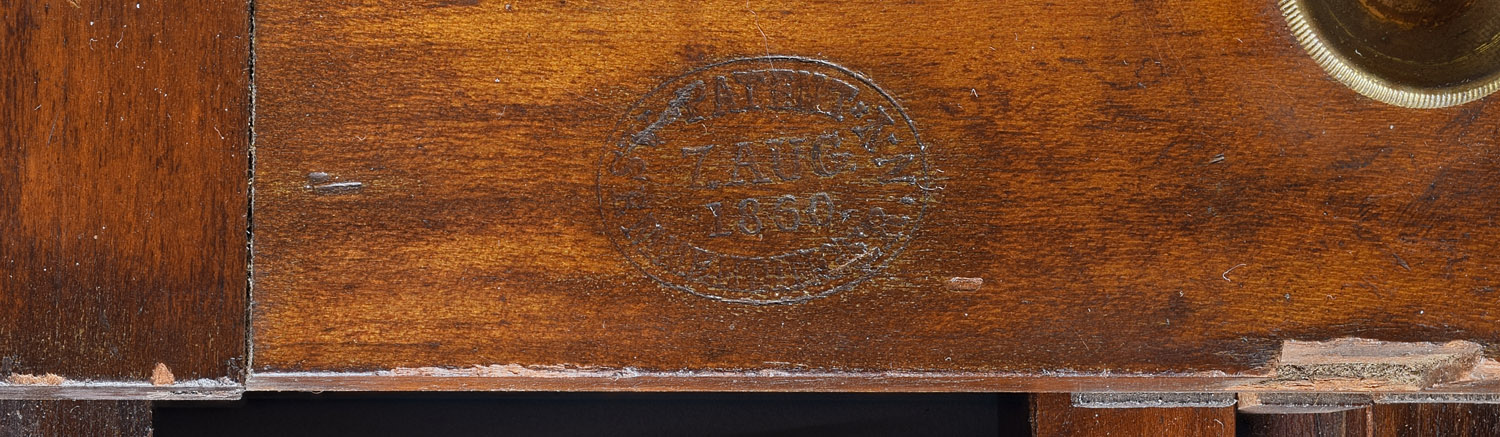
Stamp, lower deck of rear standard: "∙ Patent ∙ 7 . Aug . 1860
∙ A. Semmendinger . N,Y ∙"
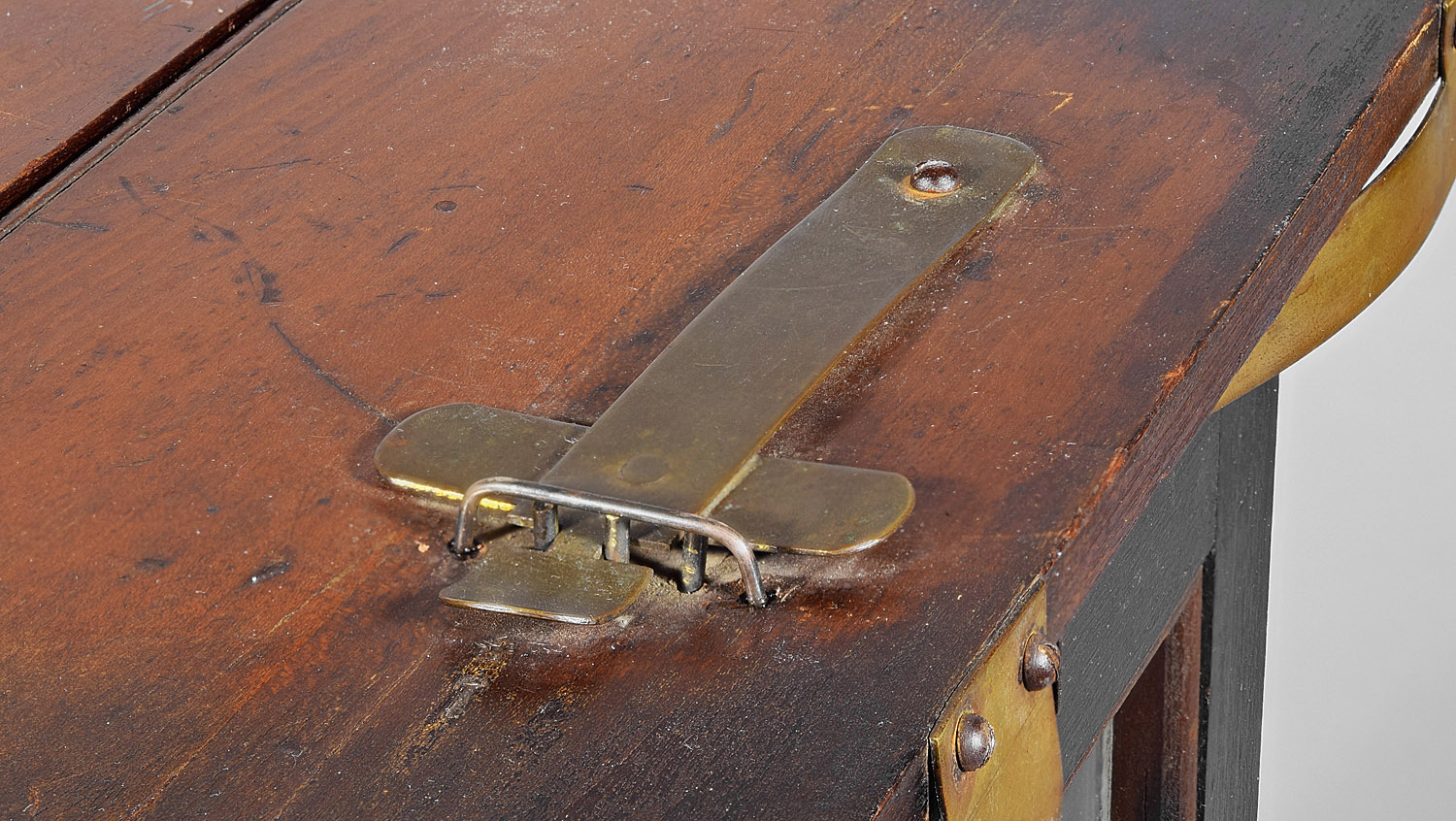
Spring brass assembly on top of rear standard
- holds and releases the ground glass frame at the center of the bellows
When
the long brass strip is pulled up, the groung glass frame is free to move; when
down, the ground glass frame is locked. The wire loop prevents the brass
strip from being lifted too far; the wire loop below is a replacement based on
other Semmendinger cameras that retain their loops..
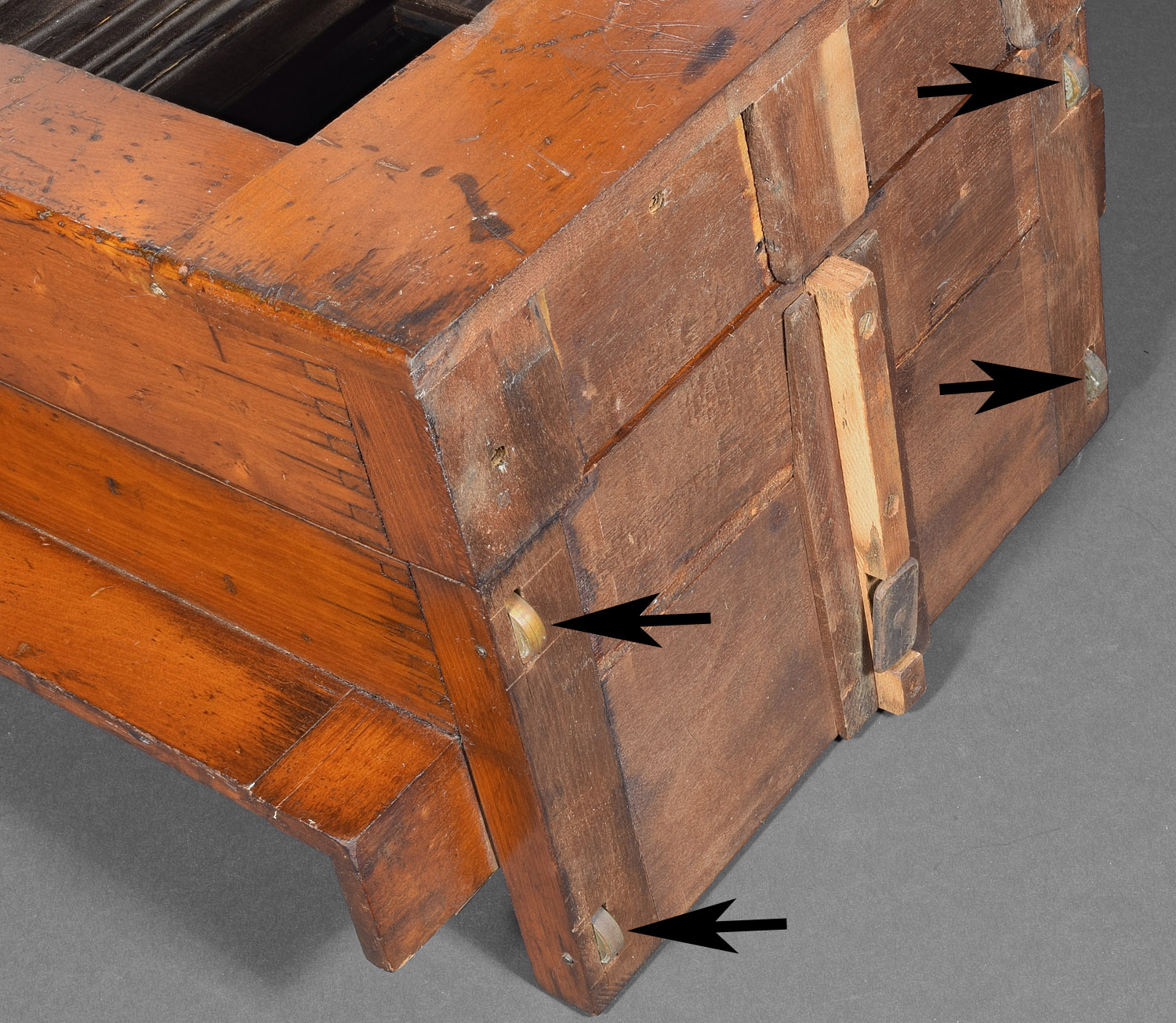
The bottom of the rear standard, showing the
four solid brass wheels on which it rides (arrows)
Date Introduced:
- ; Years Manufactured: c.
1865
Construction:
rear focus,
no swing, no front rise, straight bellows, horizontal sliding back
Materials:
mahogany body with shellac finish, platform is
probably stained cherry, plain, unlacquered brass hardware, black fabric bellows
Sizes Offered:
at least
6½x8½
Notes:
August Semmendinger (b.1820), wife and daughter emigrated from Germany to the
United States in 1849. In 1859, he established August Semmendinger & Sons
in New York City, manufacturing out of several locations what were called at the
time "camera boxes", that is, boxy-looking
cameras made of hardwood and bellows. What is now known as a box camera
was a type of camera only invented about 1886 or later. He was granted two patents in 1860 for
camera designs. Cameras were made in New York City until 1871, when he moved to
Fort Lee, New Jersey, where perhaps most of Semmendinger cameras were made.
The name "Excelsior" was adopted by August for his cameras probably around when
he moved to New Jersey, as I have only seen it on cameras also marked "Fort Lee,
N.J." (this conclusion is based on the admittedly small sample size of the three
Semmendinger cameras shown in these pages, so I can not claim to be sure about
that). It is evident that "Excelsior" was not what we would consider a
model name, in that cameras having quite different designs are so marked.
"Excelsio" must have been a name that August applied to all of his cameras -
something easier to remember than Semmendinger. August died in 1885. His sons
(Theodore b.1853, Roland b.1860, Guido b.1864, August b.1865 and Pythagoras b.?) continued making cameras for some time
after his death, but probably not long, as there seems to be no significant number of dry plate
Semmendinger cameras (i.e., ones without wet plate stains) extant.
It may be that the sons were not capable of inventing the new, light-weight
designs that would sell to the amateur dry-plate photographers of the late 1890s
and later.
An engraving of a Semmendinger portrait (studio) camera (The Photographer's Friend, Richard Walsl (Baltimore, MD), 7th
edition, 1882, p. 45) shows that it has a
platform of relatively low height that is more like a field camera than the
usual portrait (studio) camera of the time. It points out the fact that all
Semmendinger cameras, whether meant for the studio or the field have low, flat
platforms to accomodate the wheels on which the rear standard travels.
Therefore, the only difference between a Semmendinger studio camera and a
Semmendinger field camera is whether the platform does not fold (studio) or does
fold (field). This fact also explains why Semmendinger field camera seem
to be as clunky and heavy as a studio camera of the era: in that the
platforms of the studio and field cameras are the same (except for folding or
not), it is very efficient to have only one type of camera body (and the
attendent jigs and forms required for its construction), rather than two (one
heavy for studio and one light for field) as did most manufacturers. In
the wet plate era, an era which required a photographer to carry into the field
with him or her the equivalent of a studio, including a functioning dark room,
manufacturing a heavy field camera does not lose many sales.
Model/Variations
Semmendinger cameras share some
design features, in that all appear to have 1) rear push-pull focus with a
thumbscrew lock near the rear of the rear standard deck; many, if not all,
also have a combination focus lock/fine focus thumbscrew (this is two focus
locks, and none of my examples still retain all
of their fine focus parts, so I can't be sure what the full fine focus hardware
was like, but any fine focus screw must also have a focus thumbscrew to provide
a solid base from which to screw forwards or backwards), 2) folding platform, 3) a sturdy and heavy
construction, with a forward platform inches longer than need be to accomodate
the collapsed length of the camera body, 4) and a rather long rear standard that
glides along the platform on four small brass wheels. Features that
model/variations may not share are 1) the shape of front standard (some extend
out from the platform), 2) presence of a complex type of lens board rise,
involving a �" diameter by ~2" deep hole bored in the top of the lens board, 3) a
small storage compartment inside the front standard, 4) brass strips to protect
the platform where the brass wheels on the rear standard run, and any one or
another of variations common to other manufacturers, such as no swing, one
swing, two swing, hinged ground glass frame or removable ground glass frame.
To determine the models that a given
manufacturer has produced, I usually start with their published catalogs and
advertisements. My descriptions of Semmendinger cameras
suffer from a lack of catalogs and even advertisements containing engravings. A number of Semmendinger cameras are shown at the website of Paul Semmendinger:
https://semmendinger-camera.com.
The few dozen cameras shown there can be categorized into a few groups
containing common elements, but when looked at in detail, there are as many
differences than similarities.
Therefore, the
Semmendinger cameras I show on these pages may represent models, or merely
variations as they were made. For this reason, I am calling each camera
here by the wishy-washy term: "Model/Variation". The cameras shown here
are not in any way a complete
listing of model/variations that exist. However, I have been lucky in
that the three Semmendinger cameras that I have purchased in ~50 years of view
camera acquisition appear to represent one each of three main types of
construction and could be thought of as models, even though there is no literature to indicate that August
Semmendinger ever thought of them that way.
The following are
the model/variations
documented so far are: they are approximately in order of simplified
chronology, the New York (1859-1870) stamped first and New Jersey (1874-1880s) stamped later.
Semmendinger Field View Camera
Model/Variation 1:
This camera is the earliest and simplest of the three. It bears an oval
stamp on both parts of the platform and on the rear deck of the rear standard.
The printing inside the oval reads: "∙ Patent ∙ 7 . Aug . 1860 ∙ A. Semmendinger
. N,Y ∙". It was made between the patent date of 1860 and the date of
1871, when Semmendinger moved his operation to Fort Lee, N.J. The camera
lacks tilts and swings. It lacks the rising lens board controlled by a
thumbscrew on top of the front standard front like other Semmendinger view cameras
usually have.
It does have the brass wheels on which the rear standard rolls as seen on all
Semmendinger cameras to date. The focus is push-pull locked by a
thumbscrew on the rear standard deck. In the example camera for this
model/variation, there are two screw holes in the middle of the back of the rear
standard deck - a position where hardware for a fine focus screw would normally
be installed. However, there is no hole here for the fine focus screw
itself, so this model/variation did not have a fine focus screw, but what it did
have there is unknown. The lens board is removable without the use of hardware to hold it in.
Using light traps at the sides, and slots above and below, the lens board is
removed by pushing it up into a slot deep enough to allow the bottom of the lens
board to be pulled outwards, which frees the board.
The back of the camera is wider than the rest of the camera and has a wide slot into which a 1" thick ground glass frame
slides. The ground glass frame would be removed and replaced by a plate
holder, should one be available. Four large springs ensure that the frame or plate holder stays
tight to the back of the rear standard. The sliding back is a little less
than 2" longer on each side, so not much sliding is done. The ground glass
frame is only 10�" square;
this size is sufficient to cover the 9x9" bellows opening, but surely the plate holder for this camera
would have been longer in order to use the sliding aspect of the back to make
multple exposures on a single plate. This camera does not have brass
strips on top of the platform to prevent wear.
Semmendinger Field View Camera Model/Variation 2, marked Excelsior:
This is the model/variation that is most familiar due to its engraving having
been featured in various catalogs and other ads of the 1870's. It is
stamped "Excelsior" and "A. Semmendinger, Manuf�'r / Fort Lee, N.J." It is
readily recognized by its little storage compartment that sticks
out from rest of the front standard just under the lens. The compartment is ideal
for storing the two large tumbscrews used to make the platform rigid, as they
are pretty much loose and liable to be lost once the bed is folded. It is
not so deep as to be able to store a lens in it, though. It has a central pivot
double swing, vertical swing being controlled by a thumbscrew rack and pinion
drilled into the bottom of the rocking wood frame, and horizontal swing that is
push pull, locked by the same thumbscrew on the rear standard deck that locks
the focus. The rising front is controlled by a knurled size thumbscrew on
top of the front standard; the ~2�" long thumbscrew threads into the top of the
lens board, which has a threaded brass insert on its top edge, and a vertical
hole underneath it. Since the rise thumbscrew extends into the lens board
as assembled, it is necessary to unscrew the rise thumbscrew all the way out and
remove it in order to remove the lens board in the same manner as
Model/Variation 1, that is to push the lens board upwards and pull the bottom
edge out to free it from its slot. The rear standard rides on four solid brass wheels
as do other Semmendinger cameras.
The wheels on this model/variation roll on thin brass sheets screwed into the
rails of the platforms, preventing wear or damage to the wooden platform.
The focus is push-pull and is locked by a thumbscrew on the deck of the rear
standard. There is also a fine focus mechanism the screws into the middle
back of the rear standard deck, and would have a brass slider and locking
thumbscrew (this fine focus mechanism is missing in the example, but can be seen
in part in the Model/Variation 3 examples). The camera has a hinged gound
glass frame that swings out of the way to install a square holder that has two
holes along its bottom edge that engage two wooden pegs on the rear standard.
The top of the rear standard has a brass sping catch to hold the top of the
holder.
Semmendinger Field
View Camera Model/Variation 3, marked Excelsior:
This is another camera that is stamped "Excelsior" and "A. Semmendinger,
Manuf�'r / Fort Lee, N.J.", the same stamps that were used on the
Model/Variation 2, above. It does not have the storage compartment, and,
in general, a simpler design than Model/Variation 2. In is single swing
only, but the control is also a thumbscrew rack and pinion drilled into the wood
of the rocking part of the rear standard. It has the same rising lens
board as Model/Variation 2, above, with the controlling thumbscrew on the top of
the front standard. The rear standard is supported by a long board which
rides on the four brass wheels seen in all the Semmendinger Cameras to date.
The rear standard rides on the four brass wheels that are seen on all
Semmendinger cameras to date. It does not have the thin sheets of brass on
the platform rails that are on Model/Variation 2. The focus is nominally
push pull with a locking thumbscrew on the deck of the rear standard. It
also has a fine focus screw (the screw itself is missing in the example, but the
slider and slider locking thumbscrew is present). The back of
Model/Variation 3 is removable, held in the vertical or horizontal format by two
brass retainers at the bottom and a brass spring clip at the top. The
ground glass frame is held tightly in place by two large brass springs, and
slides completely out to allow a plate holder to take its place.
Back to Miscellaneous